
Sub-Total: $0.00
Overview
As data centres continue to scale to support cloud computing, AI workloads, 5G backhaul, and hyperscale interconnection, fibre infrastructure density and manageability have become critical design considerations. Diamond Optics developed a high-density, modular fibre management platform to address these evolving requirements while reducing operational complexity and cost.
Challenge: Managing Density Without Compromising Operations
Modern enterprise, carrier, and hyperscale data centres face several converging challenges:
- Rapid growth in fibre counts driven by 400G/800G optics, leaf-spine architectures, and east-west traffic
- Limited rack space, making traditional low-density patch panels inefficient
- Operational risk during changes, where reconfiguration or expansion can introduce outages
- Airflow and thermal management concerns, exacerbated by bulky cabling and poorly designed panels
- Increasing demand for structured, standards-compliant fibre management to support audits and long-term scalability
Legacy fibre patch panels often consume excessive rack units, require extensive manual intervention during upgrades, and lack the flexibility needed for modern data centre operations. These limitations increase downtime risk, labour costs, and long-term infrastructure spend.
Industry Trends Driving High-Density Fibre Design
Across global data centres, several key trends are shaping fibre infrastructure decisions:
- Higher port density per rack unit to maximise space efficiency
- Pre-terminated MTP/MPO backbone architectures to accelerate deployment and reduce installation errors
- Modular, cassette-based systems to allow incremental scaling
- Front-access maintenance to minimise disruption and improve technician efficiency
- Low-loss (Grade A) connectivity to support higher-speed optics and longer reach
- Improved cable management to maintain bend radius control, airflow, and visual clarity
These trends place a strong emphasis on systems that are not only dense, but also manageable, intuitive, and operationally safe.
Solution: Diamond Optics 1RU 144-Port FlexiPatch System
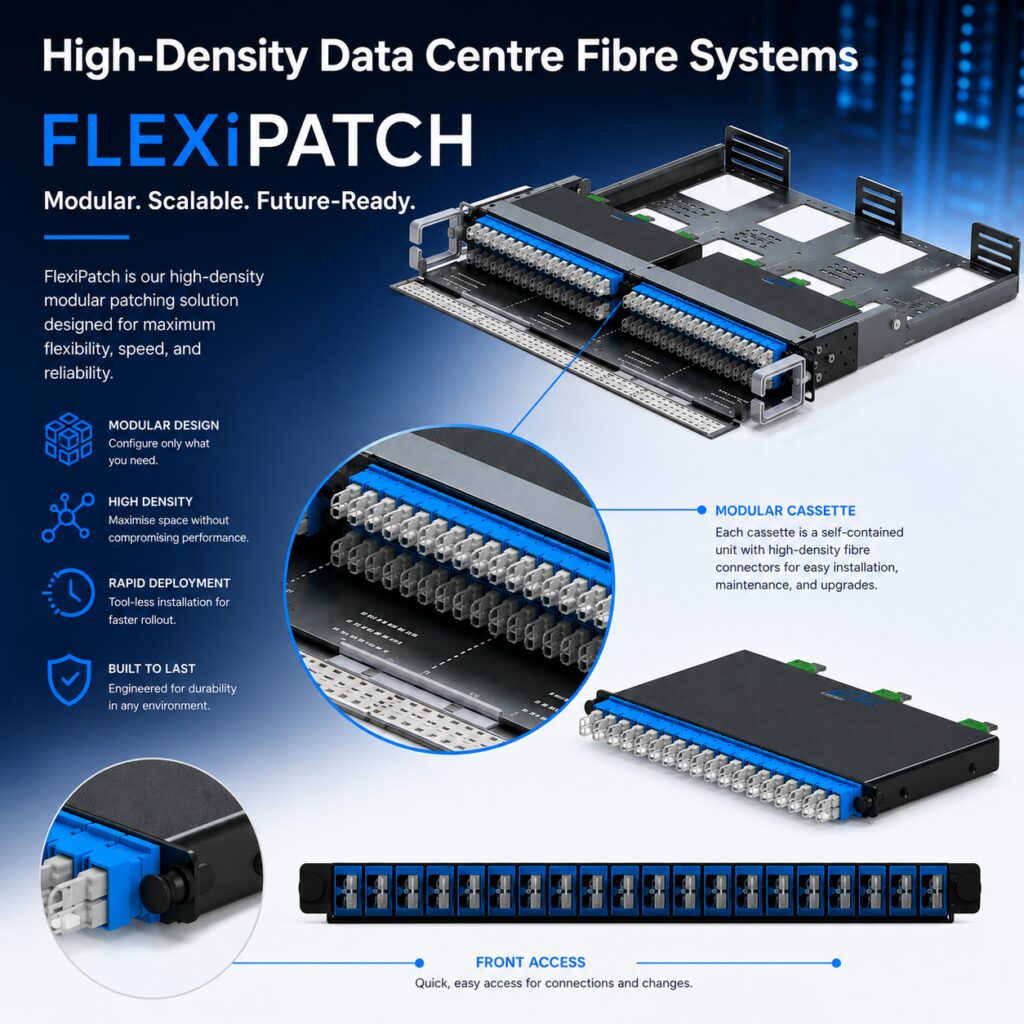
Diamond Optics designed and manufactured a 1RU High-Density FlexiPatch Fibre Sub-Rack to meet these modern data centre requirements.
High-Density, Space-Efficient Design
- Supports up to 144 LC or LCA ports in a single 1RU, when fully populated
- Uses removable, high-density modular cassettes, each supporting up to 36 LC ports via three rear MTPe 12-fibre connections
- Enables significant rack space savings compared to traditional fibre panels
Modular & Scalable Architecture
- Available cassette formats include LC, LCA, SC, SCA, and E2000
- Supports MTP-to-LC, MTP-to-SC, splitters, DWDM devices, and custom optical configurations
- Allows operators to scale incrementally, adding capacity only when required
- Type A or B polarity configurations supported to suit different network architectures
MTP/MPO Backbone Connectivity
- Rear MTP/MPO Elite connections enable fast, plug-and-play deployment
- Reduces installation time and human error compared to field termination
- Improves airflow and cable organisation by minimising bulk
Operationally Friendly Design
- Hot-swappable cassettes allow reconfiguration or expansion without service interruption
- Front access for all LC connectors, even when fully populated or stacked in HDODF environments
- Shortened front section improves connector accessibility
- Additional spacing between adapters ensures LC pull tabs and standard connectors can be removed without disturbing adjacent ports
- Integrated front and rear fibre management, including:
- Adjustable rear tray
- Cable guides, clips, and Velcro wraps
- Four flexible cable entry positions (left, right, rear, side)
Performance & Compliance
- Guaranteed Grade A connectivity with insertion loss < 0.15 dB, meeting Telstra Grade A requirements
- IEC Grade A performance available upon request using high-tolerance components
- Designed to support current and future high-speed optical applications
Future-Ready Management
- Fully compatible with Diamond Optics’ patented RFID cable management system
- Enables accurate fibre identification, documentation, and lifecycle management at scale
Outcome: Reduced Cost, Higher Uptime, Future-Proof Infrastructure
The Diamond Optics FlexiPatch system has been successfully adopted by enterprise and carrier-grade data centres seeking to improve rack efficiency, service uptime, and operational agility.
CAPEX Advantages
- Reduced rack footprint lowers space and colocation costs
- Modular cassettes allow pay-as-you-grow expansion
- Pre-terminated MTP/MPO backbones reduce installation labour and rework
- Low-loss Grade A performance extends the usable life of optical infrastructure, delaying costly upgrades
OPEX Advantages
- Faster deployments and changes reduce technician time on site
- Hot-swappable modules minimise planned and unplanned downtime
- Improved cable management lowers the risk of accidental disconnections
- Front-access design simplifies maintenance and fault isolation
- RFID-enabled management reduces documentation effort and human error
Operational Impact
- Higher port density without sacrificing accessibility
- Improved airflow and thermal performance
- Faster service turn-up for new customers or internal capacity upgrades
- A scalable platform aligned with evolving data centre architectures
Conclusion
As fibre densities continue to rise, data centres require solutions that balance performance, manageability, and scalability. The Diamond Optics 1RU 144-Port FlexiPatch system addresses these demands through a thoughtfully engineered, modular design that reduces both capital and operational costs while improving uptime and flexibility.
By combining high-density connectivity, Grade A optical performance, and intelligent fibre management, Diamond Optics delivers a future-proof fibre infrastructure platform built for modern data centre environments.